
Belize it or not?
No sooner have we arrived in Mexico than it feels like we’re already moving on to the next country. We’ve been "on the road" here for a mere two weeks. We deliberately gave the Yucatán Peninsula a wide berth—quite literally. The distances are simply too vast for the roughly two months we have available. Nevertheless, in that short time, Mexico impressed us with its Maya sites and crystal-clear waters.
Now, we’re heading for the Belizean border. Days like this are always stressful—lots of waiting, document checks, and so on. Exiting Mexico goes fairly quickly; however, to get our exit stamps, we first have to pay a tourist tax to the woman at the border—the equivalent of 60 USD per person. A hefty sum, and payable in cash, no less. We scrape together our last remaining pesos. Then we’re allowed to proceed... Wait—we didn't get a receipt. It slowly begins to dawn on us. And when, a few kilometers later, we do some quick Google searches inside the Belizean immigration building, the truth becomes clear: it was a scam! For the first time in over three years on this continent, we have fallen victim to fraud. We hadn't questioned it for a single second; something like this had never even crossed our minds before. It turns out this mysterious "tourist tax" is indeed legitimate, but it is collected upon entry into the country. When flying in, it is automatically included in the ticket price—meaning we paid double. A Swiss couple who crossed the border just ahead of us got caught out as well. It’s incredibly frustrating. Visibly annoyed, we get through the (very cumbersome and entirely analog) border formalities in Belize; then we quickly purchase third-party vehicle insurance and withdraw some cash (Belize Dollars). After about two hours, we’re finally through. Days like this are exhausting, even when everything goes according to plan.
Now, it’s another two-and-a-half-hour drive to our final destination for the day. The very next day, we plan to spend a few days on Caye Caulker—one of the most famous islands off the coast of Belize. We head for the old harbor in Belize City, where we can safely park our car. The drive drags on; moreover, the temperatures have risen significantly again since we reached the coast. But that is where the similarities with southern Mexico end. The architecture is reminiscent of Caribbean islands, the locals look much darker-skinned, and suddenly—everyone is speaking English. After so many years in South America, where Spanish was spoken everywhere, it’s almost too much for our brains to handle. Time to get some sleep.
The next morning, the world looks a whole lot brighter. We pack up and head off to the ferry terminal. The people here are truly all very friendly and laid-back—and, in a funny sort of way, a little bit spaced out, too. That’s probably down to the sweltering heat. Life on the island is casual; there are no cars—only bicycles and golf carts on the move. And countless tourists. It feels as though half the United States is spending the winter here. We knew it would be a tourist hotspot, but we certainly hadn't expected this. Naturally, this drives prices sky-high; we can't get breakfast for less than 50 USD. So why are we here in the first place? We’ve come to explore the underwater wildlife. Just off the coast of Belize lies the second-largest reef in the world—a natural wonder that supports an incredible diversity of species.

Immediately upon arrival, our first stop is the Giant Cave—or rather, the cave's entrance. It lies underwater and is accessible only to certified cave divers. In Mayan times, it sat above sea level; it is filled with stalagmites and stalactites, and Mayan pottery has even been discovered there. The Maya used the cave for their funerary rituals. For us, however, its appeal lies in its underground freshwater spring—a feature that attracts tarpon. It serves as a veritable fountain of youth for these bony fish, which can live for up to 100 years. They possess no teeth and swallow their prey whole. To hunt, they often employ a spectacular leaping behavior—and that is precisely what we have come to see. I—or rather, the fish held between my fingers—am the bait. It certainly takes a bit of courage...


The next day, I head out on a full-day snorkeling tour. Taking Diego along on the boat for six hours makes absolutely no sense. And so, he spends a relaxed day on the island with Micha. We stop the boat at various spots, snorkel over the coral reef, and swim with sea turtles. The most spectacular stop, however, is the so-called Shark Ray Alley. Sharks and stingrays teem here. No sooner have we arrived than we are surrounded (and no, we don't feed them). I do feel a bit uneasy, though, as I jump into the water. What an experience! Naturally, Micha doesn't want to miss out on this spectacle, so he takes the same tour the very next day.

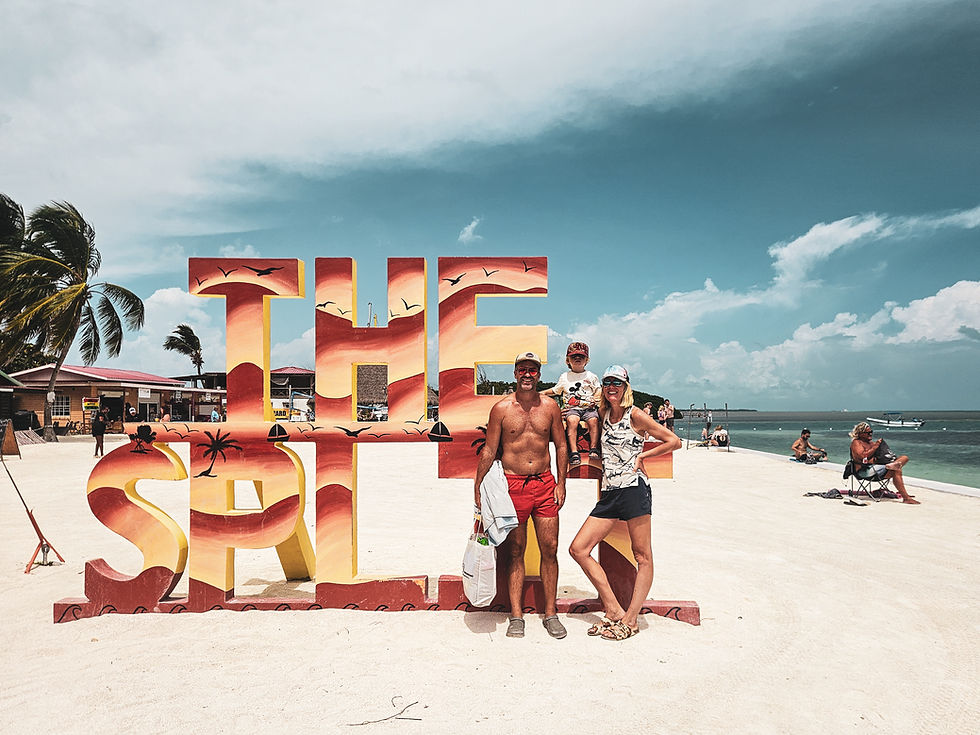
Incidentally, there are no actual beaches on the island. What you will find, however, is the legendary "Split." The island was divided into a North and a South Island by a hurricane back in the 1960s. Today, the site features a channel for boats, swimming platforms, and the "Lazy Lizard" bar. This establishment is a must-visit—as is Caye Caulker’s signature drink: the "Lizard Juice." Why the name? It’s green, and after downing three or four of them, you’ll be crawling home just like a lizard. Naturally, we put that to the test!

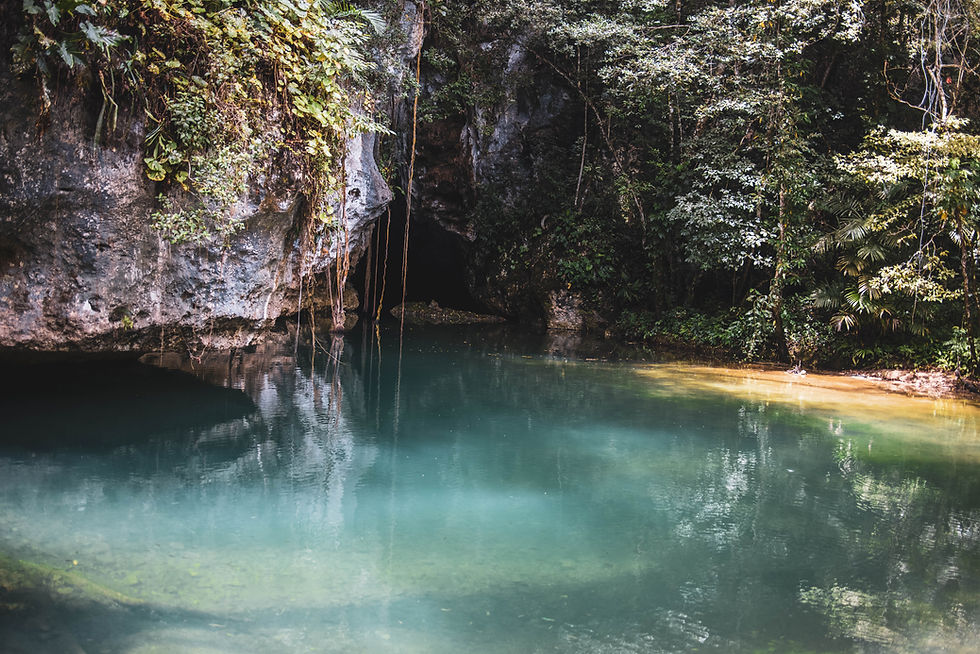
After four days, we leave the island with mixed feelings. The natural scenery was magnificent, but the mass tourism, on the other hand, is really not our cup of tea. With our camper, we hope to explore a few less crowded spots in Belize. We select a few specific destinations—specifically, beautiful campsites, many of which are run by expatriates. Unfortunately, the beaches don't have much to offer at the moment. The annual algal bloom has set in earlier than usual; due to the increased runoff of fertilizers flowing into the ocean via the Amazon, this problem is growing ever larger across the Caribbean. Regrettably, we are also unable to spot any manatees—often referred to as "sea elephants"—as the water in both the ocean and the freshwater lagoons is extremely murky, and the wind is too strong. Thus, we slowly make our way toward Guatemala, traversing the Belizean hinterland as we go. It grows even hotter, and mosquitoes plague us day and night. We want to at least capture a few impressions of the jungle before we leave, so we head to Barton Creek. Here, we find crystal-clear water and impressive cave systems that were utilized by the Maya in ancient times. We explore the landscape by kayak—naturally, with a guide. The extremely strict regulations (whether intended to protect historical artifacts or simply to fleece the tourists remains an open question) prohibit any independent exploration. So, we allow ourselves to be paddled through a small section of the cave system, which stretches for approximately eight kilometers. Our guide explains to us not only the geological origins of the caves but also the gruesome rituals practiced by the Maya—rituals evidenced by the artifacts found within, such as ceramics and skeletal remains. It offers a somewhat different perspective on the world of the Maya.
And with these experiences under our belts, after just two weeks, we are now crossing the border into Guatemala. So, what is our verdict on Belize?
Belize is—at least for us—not a standout destination. Why?
The underwater world is truly impressive; otherwise, the country doesn't have much to offer.
Moreover, the waste problem is impossible to overlook. It washes up on the beaches, and in the hinterland, there are massive dumps everywhere (or rather, heaps of scrap metal and uncollected refuse).
The heat is just imbearlable for us; furthermore, the mosquitoes and other biting insects are a genuine plague. They truly manage to squeeze through every single crack in our camper.
The cost of living is astronomical—for us, it ranks among the top three most expensive places on our entire trip, right after Uruguay and Costa Rica. This starts with guides and entrance fees—a situation almost certainly driven by the large influx of tourists from North America. Prices for food and consumer goods are inflated due to the country's heavy reliance on imports. Belize itself possesses very little industry or agriculture, and what little it does produce is mostly exported. There is hardly a single product that isn't imported—and due to strained relations with its immediate neighbors, Guatemala and Mexico, these goods typically come from other nations, primarily the USA.
It feels as though the country is overrun with Americans and Canadians—people either wintering there or who have emigrated permanently. The absence of a language barrier and the favorable legal framework for foreign investors make it an easy choice for them. On the upside, this influx has at least resulted in the existence of actual campsites; a native-born Belizean likely wouldn't recognize the need for such facilities, nor would they see the point of maintaining such standards. However, this also means the country doesn't feel particularly authentic.
In short, for us, it’s more of a case of "BELIZE IT NOT."
Comments